WHAT IS OCD?
It’s a brain based disorder
There is a presence of obsessions, compulsions or both
Obsessions and compulsions are time consuming (more than one per day)
Obsessions and compulsions cause clinically significant distress, anxiety, or discomfort
Obsessions and compulsions are not due to substance use
Obsessions must be recurrent, persistent, intrusive, and unwanted
Compulsions must be repetitive and aimed at preventing or reducing distress caused by the obsessions
HARM OCD
✳︎
CONTAMINATION OCD
✳︎
MORAL / RELIGIOUS OCD
✳︎
JUST RIGHT OCD
✳︎
PEDAPHILIA OCD
✳︎
Relationship OCD
✳︎
HARM OCD ✳︎ CONTAMINATION OCD ✳︎ MORAL / RELIGIOUS OCD ✳︎ JUST RIGHT OCD ✳︎ PEDAPHILIA OCD ✳︎ Relationship OCD ✳︎
OCD THEMES / SUBTYPES
PEDOPHILIA OCD
Obsessions, doubts, and fear of being attracted to a minor, fear of performing a sexual behavior with a minor.
“What if I am attracted to a child?; “What if I sexually assaulted a minor?”
Common compulsions include avoidance of areas where children gather (schools, daycare centers), mentally checking for arousal, seeking reassurance from loved ones or the internet.
CONTAMINATION OCD
Obsessions, doubts, fears surrounding germs, chemicals, and contaminants.
“What if I get sick”; “What if I get dirty?”; “What if I get others sick?”
Common compulsions include: hand washing, use of cleaning products, use of hand sanitizer, using a barrier to touch things, avoidance of feared substances, chemicals, and household products, mental rumination about contamination.
HARM OCD
Obsessions, fears, and doubts about hurting others or yourself either accidentally or intentionally.
“What if I harm myself or others?”; “What if I hit that person I just drove past?”
Common compulsions include: avoiding loved ones; mentally reviewing past events for certainty that you didn’t harm someone; repeatedly seeking reassurance that you did not hurt someone; googling your own name to check whether you committed a crime; retracing driving routes to make sure no one was harmed; and avoiding objects perceived as dangerous, such as knives, cars, or other sharp items.
“JUST RIGHT” OCD
Obsessions, doubts, and fear of the “not right” feeling.
“What if it doesn’t feel just right and something bad happens?”
Common compulsions include checking, walking through doors, cleaning items, doing things until experiencing the “just right” feeling. Asking loved ones to say things in just the right way.

MORAL / RELIGIOUS OCD
Obsessions, doubts and fear of offending God or fear of not having salvation. Fear of being immoral or doing things that doesn’t line up with your morals/religion.
“What if I offended God?”; “What if I do something that goes against my morals?”
Common compulsions include praying over and over, praying or behaving “perfectly”, saying religious words or phrases over and over, avoidance of blasphemous or “immoral” thoughts, and mental review of behaviors check if they were “good” or “bad”.
RELATIONSHIP OCD
Obsessions, fears and uncertainty about whether your partner is “the one”.
“What if I don’t actually love my partner?”; “What if I cheat on my partner?”; “What if my partner isn’t attractive enough for me?”
Common compulsions include: hyper focusing on partner’s flaws, checking for attraction to partner, analyzing your feelings about your partner, comparing physical, mental, and emotional characteristics of your partner to other individuals, and reassurance seeking.
TREATMENT FOR OCD
EXPOSURE RESPONSE PREVENTION
The gold standard treatment for OCD is called Exposure and Response Prevention (ERP). ERP is an evidence based, step-by-step therapy where you work together with a therapist to face the thoughts, situations, or urges that trigger your anxiety and doubt. These are the things OCD tells you are dangerous or need to be fixed right away.
Instead of avoiding these fears or doing compulsions to feel better, your therapist helps you practice not responding to them. At first, this can feel uncomfortable, but over time your brain learns that you are actually safe. As you repeatedly face your fears without doing compulsions, the anxiety naturally fades on its own.
With practice, your brain forms new, non-threatening memories around the thoughts or situations that once felt overwhelming. This helps OCD lose its power and allows you to feel more in control of your life again.
MEDICATION
Selective Serotonin Re-uptake Inhibitors (SSRIs) have been found to be effective in reducing the symptoms of OCD and improving overall functioning.
Tricyclic Antidepressants (TCAs) are highly effective and sometimes considered a gold standard, but often reserved due to more significant side effects.
COMBINED TREATMENT
A combination of ERP and medication (SSRIs, TCAs) can be highly effective, especially when patients’ symptoms are in the severe or extreme range.
HOW TO SUCEED IN YOUR OCD TREATMENT
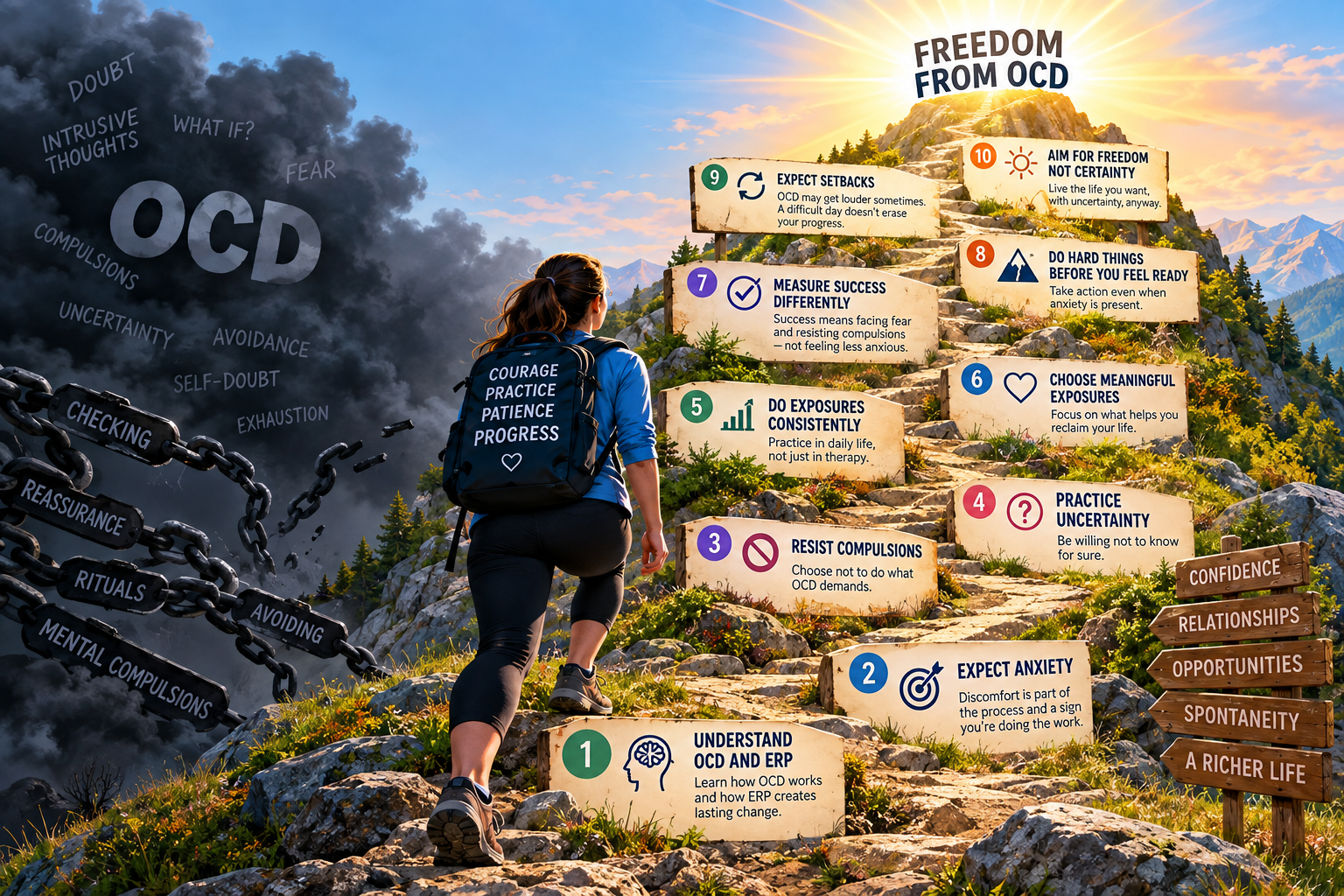
Expect anxiety and distress. Don’t wait for it to disappear
ERP works by learning that you can experience anxiety, uncertainty, or discomfort without needing to escape it or perform a compulsion. Feeling anxious during an exposure does not mean you are doing it wrong. It means you are doing it right!
Practice being uncertain instead of trying to feel certain
OCD wants guarantees: “What if this happens?” “How do I know for sure?” ERP teaches you to make room for uncertainty rather than trying to eliminate it. Try: “Maybe, maybe not. I’m willing to live without knowing for sure. I will never know.”
Focus on resisting compulsions, not on getting rid of thoughts
You cannot completely control which thoughts, images, urges, or feelings show up. You can change how you respond to them. The goal is not to stop having intrusive thoughts; it is to stop treating them like emergencies.
Watch for sneaky compulsions
Compulsions are not always obvious behaviors like checking or washing. They can include reassurance seeking, reviewing memories, analyzing thoughts, confessing, researching, avoiding, mentally checking your feelings, or trying to “figure it out.”
Do exposures consistently, not just during therapy
ERP becomes more effective when you practice between sessions. Small, frequent exposures in everyday life can be more valuable than waiting for one big exposure during your therapy appointment.
Choose exposures that matter to your life
ERP is not about making yourself uncomfortable just for the sake of being uncomfortable. The purpose is to help you reclaim things OCD has taken away—relationships, school, work, independence, enjoyment, spontaneity, or freedom.
Stop measuring success by how anxious you feel
A successful exposure does not require your anxiety to decrease. Instead ask: “Did I face what OCD wanted me to avoid? Did I resist the compulsion? Did I allow uncertainty to be there?” If yes, the exposure was productive.
Be willing to do hard things before you feel ready
Waiting until you feel completely confident or comfortable can become another form of avoidance. Courage in ERP means taking action while anxiety and uncertainty are still present.
Expect OCD to fight back sometimes
Progress is rarely perfectly linear. OCD may get louder when you begin changing your responses, and symptoms may fluctuate during stressful periods. A difficult day does not erase your progress. Return to the skills you have been practicing.
Aim for freedom, not certainty
ERP is ultimately about learning: “I can have this thought. I can feel this feeling. I can tolerate not knowing. And I can keep living my life anyway.” The goal isn't to win every argument with OCD. The goal is to stop letting OCD make your decisions.